Engineering guide
Industrial fan selection starts with the duty point, not the fan name. Airflow and static pressure define the operating requirement; temperature, contaminants, installation geometry and control strategy determine which construction is safe and efficient.
1. Define the duty point
Record the required airflow in CFM or m³/h and the required pressure at the design condition, stating whether the pressure basis is static or total. Include duct, filter, coil, damper and terminal losses. A selection without a verified system resistance is only a guess.
2. Match the fan family
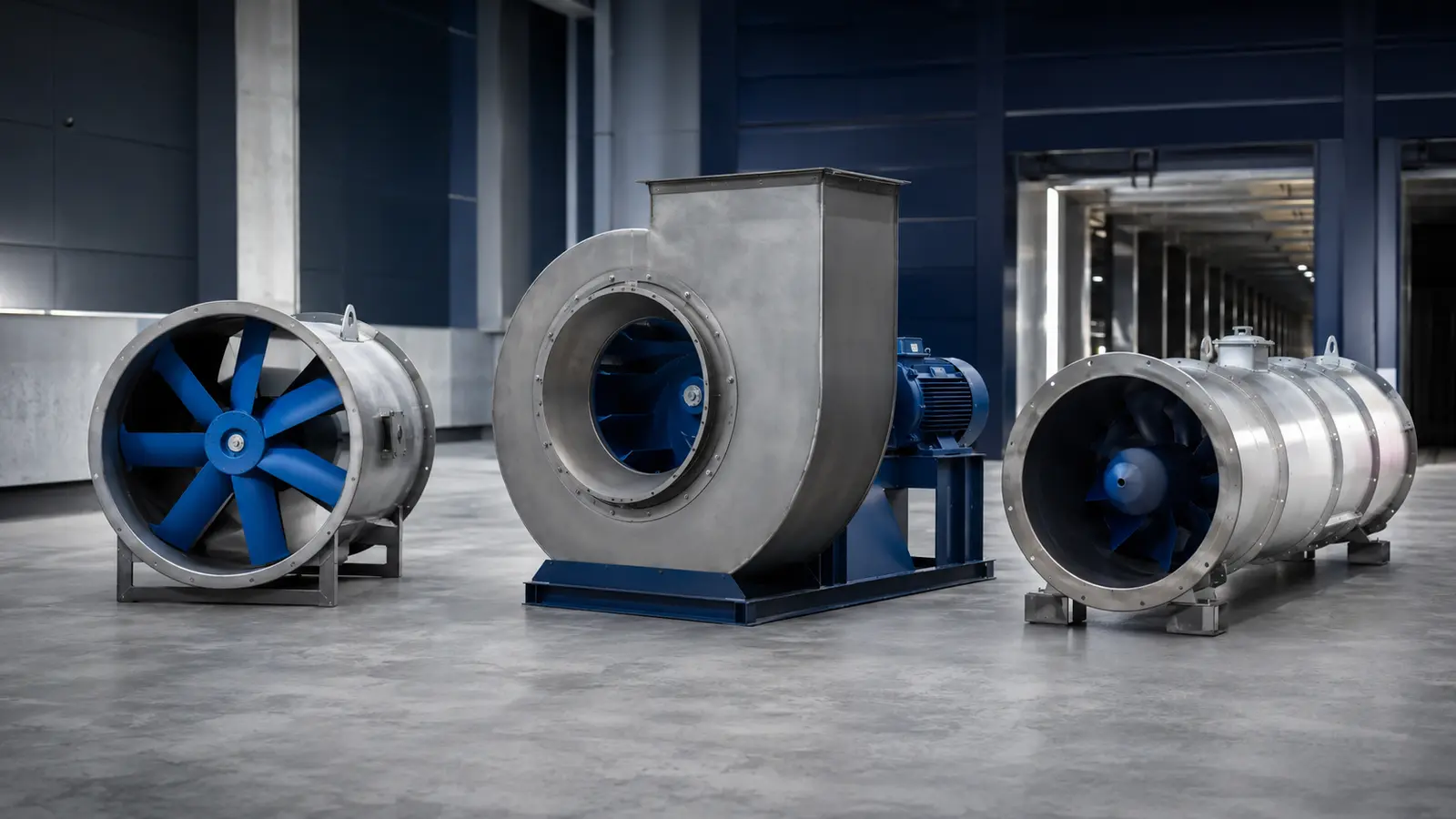
- Axial fans suit high airflow at low-to-medium pressure.
- Centrifugal fans are preferred when pressure, filtration or duct resistance is higher.
- Jet and smoke fans serve car parks, tunnels and smoke-control strategies.
- Utility and custom fans cover constrained layouts and project-specific duties.
3. Check the operating envelope
Confirm motor power, efficiency, sound, speed, materials, coating, ambient temperature, service access and applicable smoke-rating requirements. Select near the stable, efficient region of the fan curve and allow a sensible control margin.
4. Submit complete project data
Provide the duty schedule, drawings, electrical supply, environmental conditions and required standards. RAFAVENT can review the data and prepare a project-focused selection.
Next step: explore the product range or send your project specifications.
Check the manufacturer and scope of supply
IRAN FAN is the Iranian brand of Jahan Tahvieh Iranian; RAFAVENT is the international brand of the same group. Read the industrial fan manufacturer profile for the group identity, fan families, the distinction between group manufacture and third-party supply, and an original photograph of work on a fan casing.
For any manufacturer’s technical proposal, review the exact model and revision, duty point, pressure basis, construction details and test documents for the proposed configuration.
How to compare industrial fan suppliers fairly
Issue the same requirement sheet to each supplier. Compare prices after technical compliance and delivery scope are clear. The following review checklist is proposed for every supplier, including RAFAVENT.
Proposed industrial fan tender comparison checklist| Criterion | What to request | How to compare |
|---|
| Duty point | Airflow, static or total pressure basis, temperature, speed and air conditions | Use matching conditions and the proposed installation arrangement. |
|---|
| Construction and supply scope | Actual manufacturer, model and revision, materials, drawings and included items | Separate group manufacture, third-party supply and exclusions. |
|---|
| Performance evidence | Curve and data origin; test report where required by the project | Distinguish calculated from measured values and match the proposed configuration. |
|---|
| Claimed certification | Document, issuer, product scope and current status | A company name or displayed logo alone does not verify a model. |
|---|
| Delivery and acceptance | Document schedule, inspection method, acceptance criteria and delivery schedule | Resolve commitments and exceptions before ordering. |
|---|
| Service and cost | Warranty terms, spares, installation, transport and service boundaries | Compare equivalent scope and identify separately priced items. |
|---|
Verify product certification claims
If AMCA certification is claimed for a product, check the manufacturer, product and certification scope through the official AMCA Certified Ratings Program and product directory. This is a verification resource, not a claim that IRAN FAN or RAFAVENT holds AMCA certification.
Send a comparable enquiry
For RAFAVENT engineering review, include drawings, duty point and operating conditions, required documents and supply boundaries. Record unresolved items as questions for the final proposal; missing documentation is not a conclusive performance result.